MARD Beads: Color Codes, Sizes, and Palette Checks
Read MARD color codes without confusing a 221-color standard range, an extended reference, a retail bundle, or a screen swatch with the physical beads in your hand.
BeadsHub Studio
Author
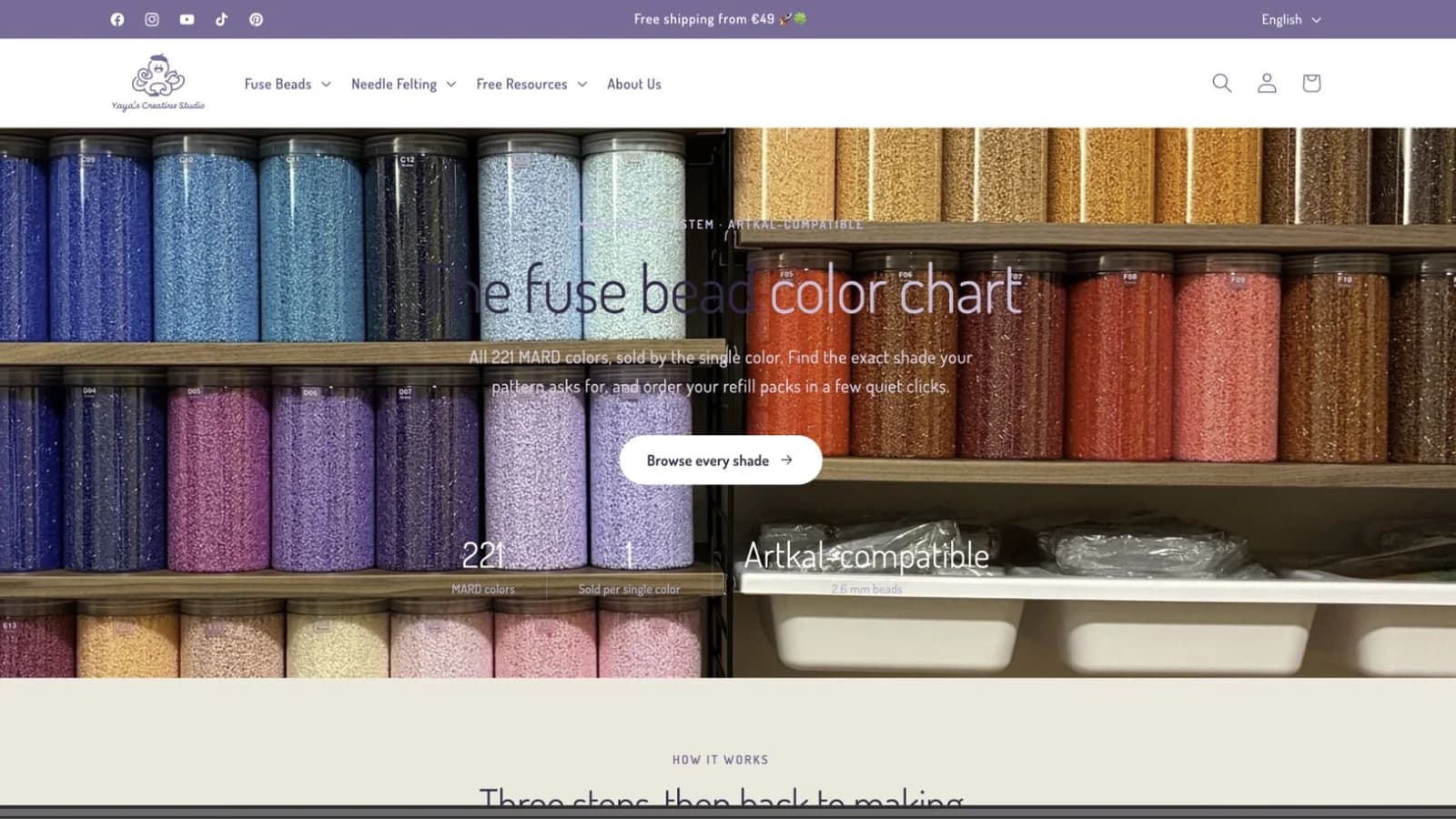
MARD beads are commonly identified with letter-and-number color codes such as A14, C5, and H7. Those codes are useful because a pattern can name a shade without relying on a vague label such as “bright red” or “deep blue.” The difficult part is knowing which color range, physical size, and seller mapping the pattern expects.
Current online references do not form one perfectly documented official catalog. Some index 221 standard colors, some add extended families for 291 colors, and some retailers use the MARD code system for compatible beads made or sold under another brand. A screen HEX value is also only a preview. This guide separates those layers so you can check a pattern before buying hundreds of beads.
Sources, independence, and real-image credits
The images in this article are real website and product-interface captures, not AI-generated substitutes. The Hero and 221-color grid come from Yaya's Creative Studio's current fuse-bead color chart, which describes its own stock as 2.6 mm, Artkal-compatible, and mapped to 221 MARD codes. The 291-color interface comes from the independent PixelBeads MARD reference. The BeadsHub image shows the live MARD 221 palette in our own maker. All pages were checked on August 2, 2026.
We did not find a manufacturer-operated MARD global catalog that could be verified as the single official source. PixelBeads calls its page official, but BeadsHub treats it as an independent reference rather than proof of manufacturer status. Retailer descriptions establish what that retailer sells; they do not establish universal specifications for every product carrying a MARD code.
MARD and other product names may belong to their respective owners. BeadsHub uses them for compatibility and reference, without claiming sponsorship or affiliation. Our terms explain the same palette and physical-match limits.
What does a MARD color code mean?
A MARD code is an address in a color system. The letter identifies a family and the number identifies one position within that family. In the commonly referenced standard range, the families are A through H, plus M.
The code is more dependable than an English color name because names vary by seller and language. One shop may call A14 tomato, another may use red-orange, and a pattern may display only the code. The code lets you compare records without assuming the names are identical.
It does not prove four other things:
- the bead's diameter;
- the plastic formulation or melting behavior;
- an exact physical color under every light and production batch;
- compatibility with another brand's pegboard or beads.
Think of the code, palette version, seller, and bead size as four separate fields. A pattern that supplies only one of them is incomplete for purchasing.
MARD 221 vs. 291: why are there different totals?
The clearest current independent reference separates a 221-color standard range from a 291-color full reference. Its 221 range contains nine families: A, B, C, D, E, F, G, H, and M. The 291 view adds six extended families: P, Q, R, T, Y, and ZG.
| Reference range | Families | Color total | Practical meaning |
|---|---|---|---|
| Standard | A-H and M | 221 | The broad code range shown by current 221-color sellers and references |
| Extended | P, Q, R, T, Y, and ZG | 70 | Additional families that may not be stocked by a 221-color seller |
| Full reference | Standard plus extended | 291 | A lookup range, not a promise that one retailer carries every code |
The standard-family counts in the current references are A 26, B 32, C 29, D 26, E 24, F 25, G 21, H 23, and M 15. Those values add to 221. The extended counts are P 23, Q 5, R 28, T 1, Y 5, and ZG 8, adding 70 more.
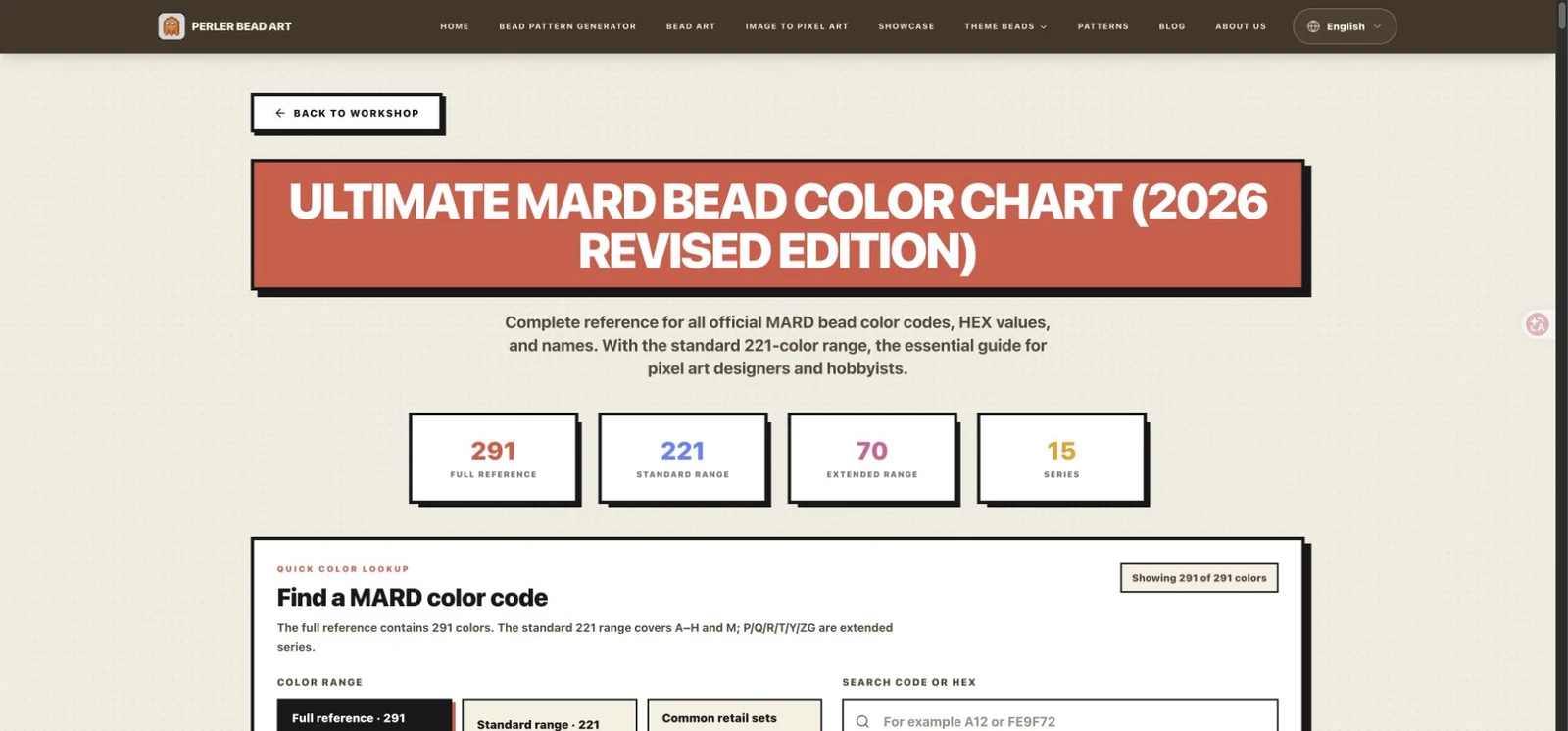
Source: PixelBeads MARD color chart, captured August 2, 2026. Shown as an independent lookup interface, not as a verified manufacturer catalog.
A retail set count is a different question
Counts such as 24, 48, 72, 96, 120, 144, or 264 often describe a particular bundle or palette snapshot. Do not assume a 144-color set contains “the first 144” entries from the 221 range. A merchant can choose a useful assortment rather than a continuous sequence.
Record the exact chart or seller used by your pattern. If the pattern asks for a code outside your set, replace it deliberately after comparing real beads; do not silently substitute the nearest screen swatch.
How to read A1, A01, and other code formats
Some charts print A1; others print A01. The leading zero is usually display formatting, so both point to the first entry in family A within the same 221-style mapping. The same applies to pairs such as C5 and C05.
Do not remove letters or merge ranges. M1 and A1 are different colors, and ZG1 belongs to an extended family rather than family Z. Copy the complete code into your shopping list.
For a large project, add columns for code, displayed name, quantity, palette version, size, seller, and a physical-swatch note. This small ledger prevents a code copied from one catalog from being ordered against another catalog without review.
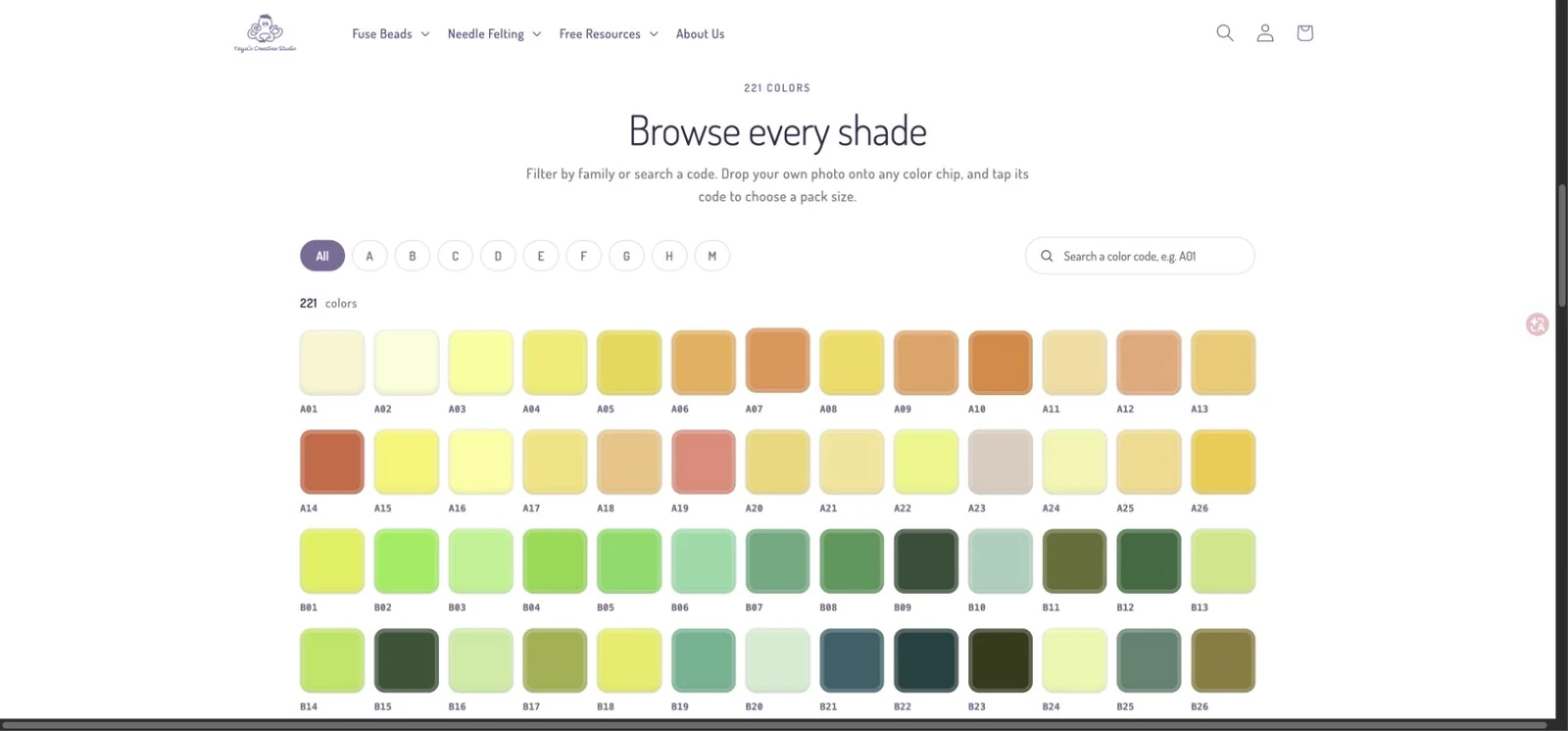
Source: Yaya's Creative Studio 221-color chart, captured August 2, 2026. The page maps the seller's 2.6 mm Artkal-compatible stock to MARD codes.
Are MARD beads 2.6 mm or 5 mm?
The code system alone does not answer that question. Yaya's current 221-color chart describes the products it sells as 2.6 mm mini fuse beads. By contrast, current BitBead pages label entries in their MARD 221 reference, including C5, as 5 mm midi. These are third-party descriptions of their own mappings, and the disagreement is exactly why a code should not be treated as a diameter specification.
Before mixing supplies, check:
- the diameter printed on the bag or product page;
- the peg spacing and board system;
- the bead height and wall thickness;
- the manufacturer's or seller's mixing guidance;
- a small fuse test using the actual colors.
A 2.6 mm bead and a 5 mm bead cannot share the same peg spacing. Even two products with the same nominal diameter can melt at different rates. Build a small striped sample before committing to a portrait or multi-board design.
Why the screen HEX value is not a physical color promise
Digital references usually attach an RGB or HEX value to each code. That value allows software to find a nearby swatch, render a preview, or compare two palettes mathematically. It does not measure the bead in your room.
Appearance changes with monitor calibration, brightness, ambient light, bead translucency, surface gloss, camera white balance, production batch, and whether the bead has been fused. The PixelBeads reference explicitly describes its HEX values as on-screen approximations and warns that physical beads can vary with lighting and batch.
Use screen color for planning. Use a physical color card, labeled sample board, or beads from the intended batch for final decisions. Skin tones, nearly neutral grays, pale yellows, and dark blue-green shades are especially easy to confuse on a bright display.
Make a reusable physical swatch board
Place one bead of every owned code on compatible boards, fuse the sample consistently, and label both the code and source. Photograph it only as a backup; keep the physical board as the deciding reference. If you buy a new batch and an important shade looks different, add a dated second sample instead of overwriting the old record.
Choose the right MARD palette before converting an image
Start with the beads you can actually obtain. A 291-color preview is not useful if your supplier stocks only the standard 221 range, and a 221-color conversion is too broad if you own a 48-color starter set.
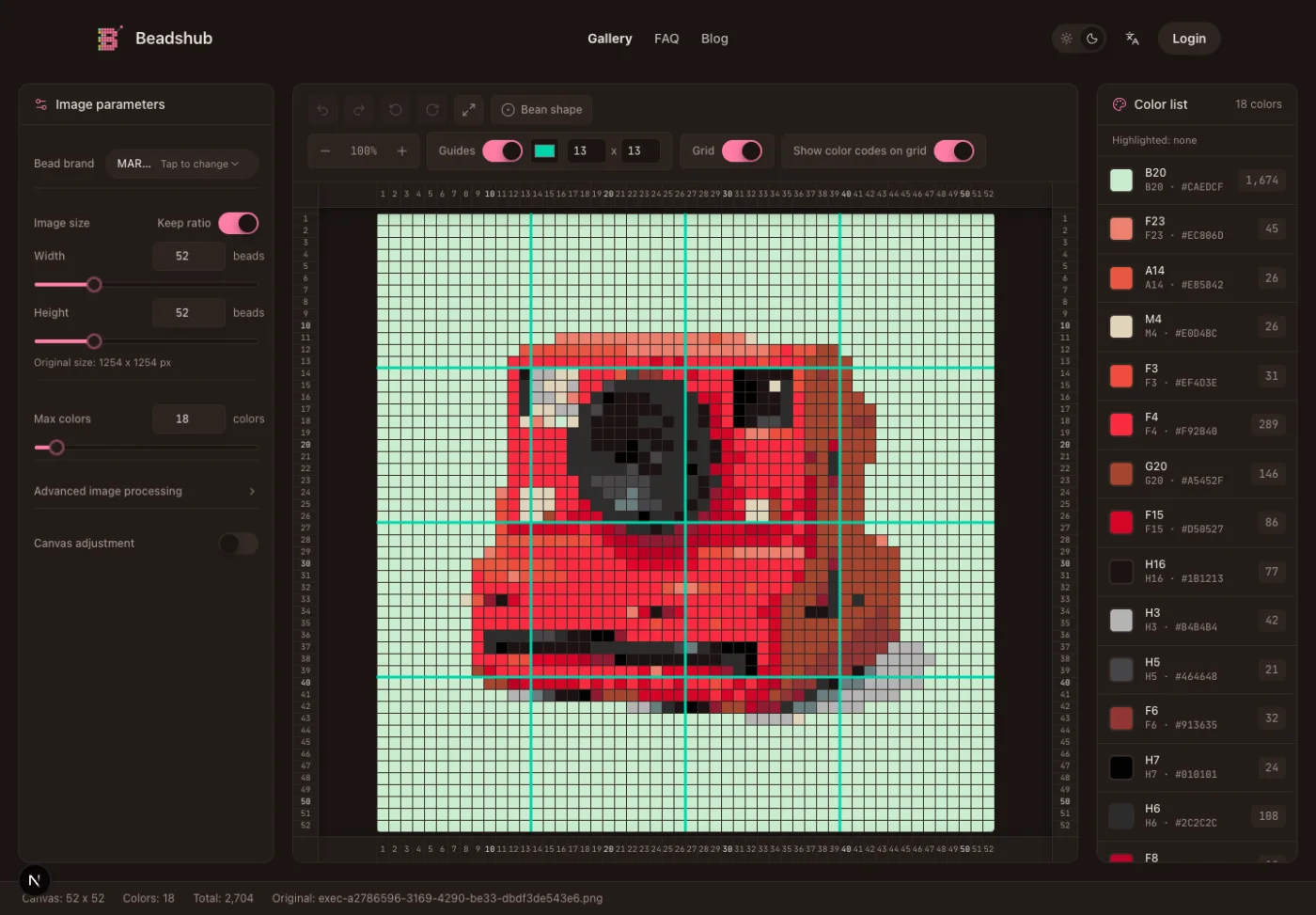
In the BeadsHub pattern maker, choose the relevant bead brand and palette before judging the converted colors. The current maker defaults to MARD 221 and exposes the code on each color swatch. It can generate a grid, color list, quantities, and printable PDF; it cannot guarantee that a monitor preview matches a physical batch.
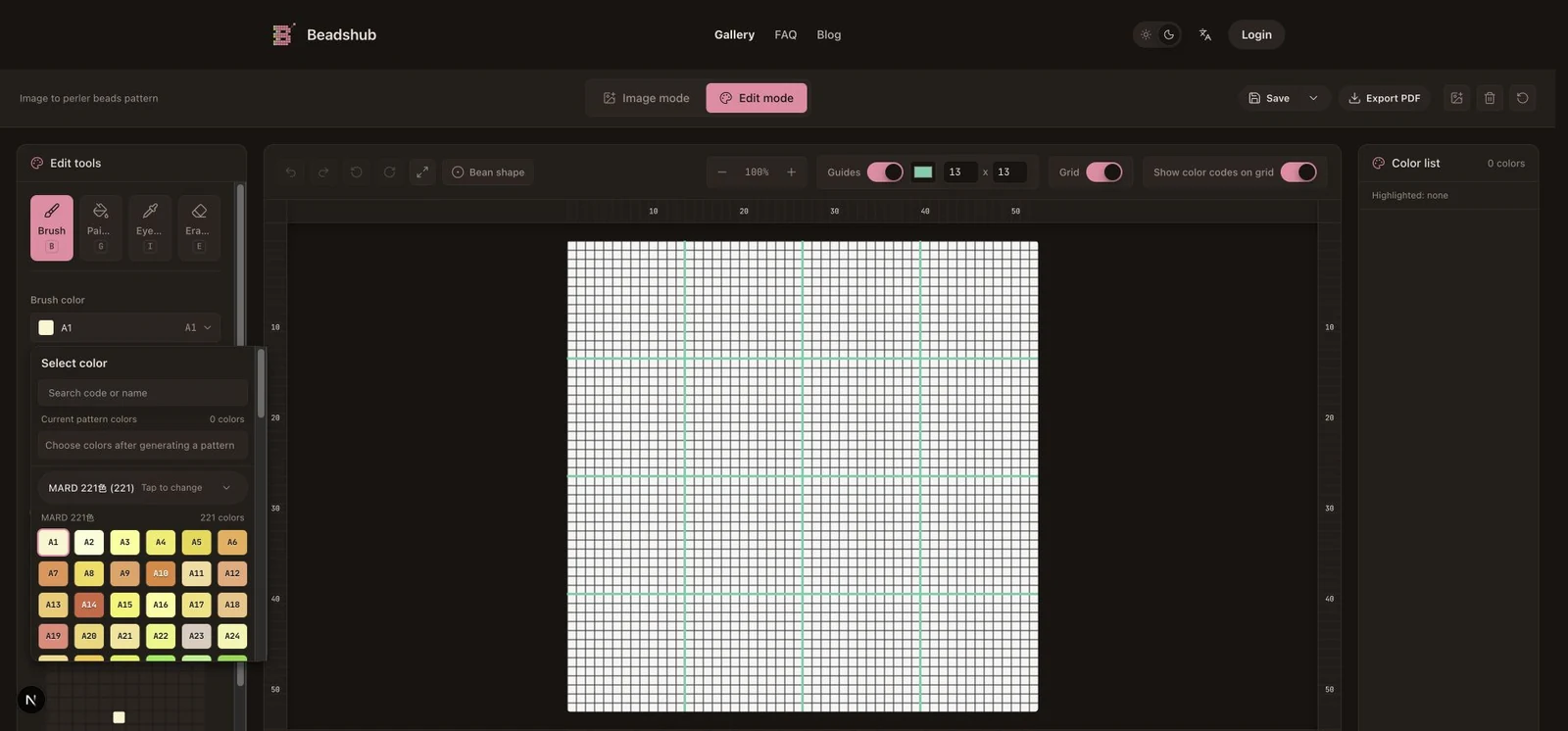
Source: the live BeadsHub pattern maker, captured August 2, 2026. This is a real first-party interface screenshot, not an AI mockup.
Use this sequence:
- Confirm the palette version named by the pattern or seller.
- Select that range before uploading or drawing.
- Limit the image to colors you own or can source.
- Review the generated color list for out-of-range codes.
- Compare critical shades against physical samples.
- Print or export only after substitutions are final.
The complete pattern-making guide explains crop, grid size, color count, cleanup, and PDF checks. For photographic sources, the image-to-pixel-art guide covers silhouette and palette reduction before physical color verification.
Can you match MARD codes to Perler or Artkal colors?
You can estimate a match, but an RGB-nearest result is not proof of physical equivalence. Two beads may share a similar HEX preview yet differ in transparency, gloss, warmth, or fused appearance.
Treat a retailer's compatibility statement as product-specific. For example, Yaya says its 2.6 mm stock is Artkal-compatible and maps it to MARD codes. That does not make every item described elsewhere as MARD universally interchangeable with every Artkal line. Artkal itself has multiple size and series families.
For a cross-brand project:
- match diameter and pegboard first;
- compare unfused and fused samples under the same light;
- avoid alternating brands inside a flat color region until the test looks uniform;
- record the exact brand code used for each substitution;
- buy enough of critical background and skin shades from one batch.
The beading software comparison explains why craft-specific palette data matters, while the fusing guide covers heat and cooling checks after the palette is settled.
A practical MARD bead buying checklist
Before placing an order, verify each line rather than trusting the chart title:
| Check | What to record |
|---|---|
| Pattern range | 221 standard, 291 full reference, or a named retail set |
| Complete code | Letter family plus number, such as C5 or ZG4 |
| Physical size | Diameter and compatible board |
| Product identity | Brand, line, seller, and product URL |
| Quantity | Pattern count plus a reasonable spare allowance |
| Color evidence | Physical sample, current seller photo, or screen-only estimate |
| Batch note | Purchase date or lot information for colors that must stay uniform |
If a listing gives a MARD code but omits diameter, request the missing specification before ordering. If a pattern gives only a color name, locate its original chart or choose a replacement from your own physical palette. Uncertainty is cheaper to resolve before the project covers several linked boards.
MARD beads FAQ
What are MARD beads?
The term is used for MARD-branded products and for a letter-number color-code system used by patterns, reference sites, and compatible-product sellers. Check the specific product, because a code-system mapping does not by itself establish brand, size, or material.
Is MARD 221 the same as MARD 291?
No. The current independent reference treats 221 as the standard A-H and M families. Its 291 view adds 70 entries across P, Q, R, T, Y, and ZG. A seller carrying 221 colors may not stock those extended codes.
Are all MARD beads 2.6 mm?
Do not assume that. One current retailer maps 221 codes to its 2.6 mm products, while another current reference labels the same MARD 221 system as 5 mm midi. Confirm the exact bag, listing, and board compatibility.
Is A01 different from A1?
Within the same palette mapping, the leading zero is normally formatting, so A01 and A1 refer to the same numbered position. Keep the family letter and verify the palette version.
Can I choose a MARD color from its HEX value alone?
Use HEX to search or make a draft, not as the final physical decision. Compare actual beads for important shades because displays, lighting, finish, and production batches change how the color appears.
Where can I find an official MARD color chart?
As of August 2, 2026, we could not verify a manufacturer-operated global catalog as the definitive source. Use a current reference and the seller's own chart together, record which version you used, and verify the final colors physically.
The safest way to use MARD beads is to keep code, palette range, physical size, and seller identity attached to every decision. A 221 or 291 label narrows the lookup, but only the actual product and a physical sample can confirm what belongs on your pegboard.